
Thu Dau Mot University Journal of Science

Search Papers
2 papers
This study applies a first-order Markov chain to analyze and model the academic progression of 317 students from the Faculty of Education at Thu Dau Mot University, utilizing their semester Grade Point Averages (GPA) as the core data. Students' GPAs were methodologically classified into four distinct academic performance states: Weak (0–4.99), Average (5.0–6.99), Good (7.0–7.99), and Excellent (8.0–10.0). Transition matrices were constructed to capture the movements between these performance states across consecutive semesters. Descriptive analysis reveals a positive performance trend, specifically a frequent transition from the Average to the Good group, and a high level of stability observed within the Excellent group, particularly in the later stages of the program. A crucial Chi-square test for homogeneity revealed statistically significant differences, indicating that the learning process is non-homogeneous over time, reflecting fluctuations in student learning behavior. However, to fulfill the objective of forecasting the expected distribution of student performance in the subsequent semester, a weighted average transition matrix was computed, giving greater emphasis to the influence of more recent academic data. Forecasting results suggest that approximately 90% of students are expected to concentrate within the Good and Excellent categories, confirming a high standard of academic performance and providing valuable empirical evidence for targeted student support and curriculum management within the Faculty of Education.
Suggestions for training strategy of Thu Dau Mot University in the process of approaching industrial revolution 4.0
Trinh Phuong Thao
Industrial Revolution 4.0 has become an indispensable trend in the development process of Vietnam and is increasingly applied in university education. The essence of the Industrial Revolution 4.0 is the application of technology, data science and the use of artificial intelligence for production and human life. In this impact, modern education, especially higher education, is the field most affected. Online teaching, with tools to support the teaching of the digital age, has been changing dramatically in the teaching and learning situation in universities, helping to modernize education and integrate with the world, but there are many issues that teachers and managers must consider to change teaching methods and training strategies, in order to deliver the best results. Starting from the actual situation, we propose specific and comprehensive measures to improve the teaching efficiency of Thu Dau Mot University and, to meet the needs of Vietnamese society and the development of Industrial Revolution 4.0.
Publication Information
Publisher
Thu Dau Mot University, Viet Nam
Editor-in-Chief

Assoc. Prof. Nguyen Van Hiep
Thu Dau Mot University
Thu Dau Mot University
Editorial Board
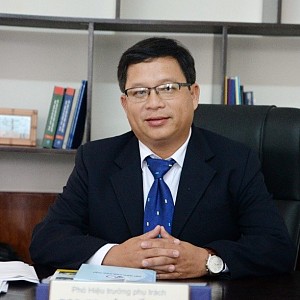
Assoc. Prof. Le Tuan Anh
Thu Dau Mot University
Thu Dau Mot University

PhD. Nguyen Quoc Cuong
Thu Dau Mot University
Thu Dau Mot University

PhD. Doan Ngoc Xuan
Thu Dau Mot University
Thu Dau Mot University

PhD. Nguyen Khoa Truong An
Thu Dau Mot University
Thu Dau Mot University

Assoc. Prof. Nguyen Thanh Binh
Thu Dau Mot University
Thu Dau Mot University

PhD. Le Thi Thuy Dung
Thu Dau Mot University
Thu Dau Mot University

PhD. Ngo Hong Diep
Thu Dau Mot University
Thu Dau Mot University

PhD. Nguyen Duc Dat Duc
Ho Chi Minh City University of Industry and Trade
Ho Chi Minh City University of Industry and Trade
Assoc. Prof. Nguyen Van Duc
Animal Husbandry Association of Vietnam
Animal Husbandry Association of Vietnam

PhD. Nguyen Thi Nhat Hang
Department of Education and Training of Binh Duong Province
Department of Education and Training of Binh Duong Province

PhD. Nguyen Thi Cam Le
Vietnam Aviation Academy
Vietnam Aviation Academy

PhD. Trần Hạnh Minh Phương
Thu Dau Mot University
Thu Dau Mot University
M.A. Pham Van Thinh
Thu Dau Mot University
Thu Dau Mot University

PhD. Nguyen Thi Lien Thuong
Thu Dau Mot University
Thu Dau Mot University
Prof. Le Quang Tri
Can Tho University
Can Tho University
Prof. Banh Quoc Tuan
Thu Dau Mot University
Thu Dau Mot University